Every auto transport website has this page. Most of them say the same thing: "Open is cheaper, enclosed is safer, the choice is yours!" That's technically true but completely unhelpful.
Here's what I'll tell you instead. I've been in the auto transport business long enough to know that about 85% of the people asking about enclosed shipping don't actually need it. They're spending an extra $500-$800 because they're nervous, not because their vehicle requires it.
So let me save you some money. Or confirm that yes, you should absolutely go enclosed. Either way, you'll know by the end of this post.
What Open Car Shipping Actually Looks Like
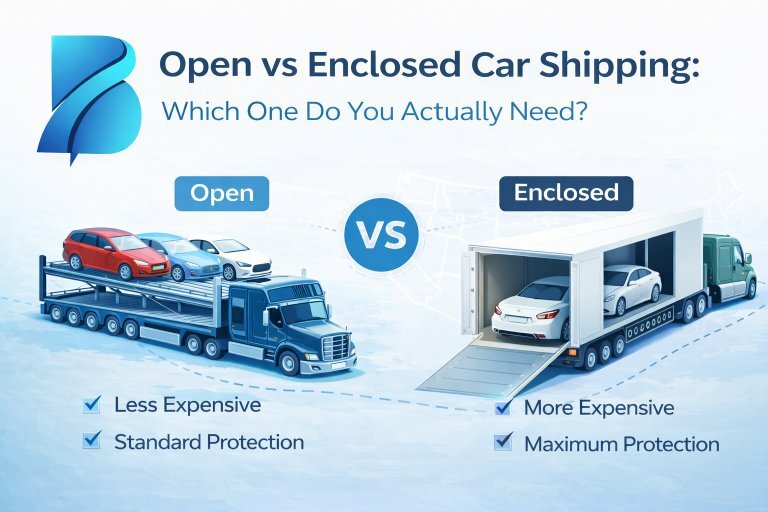
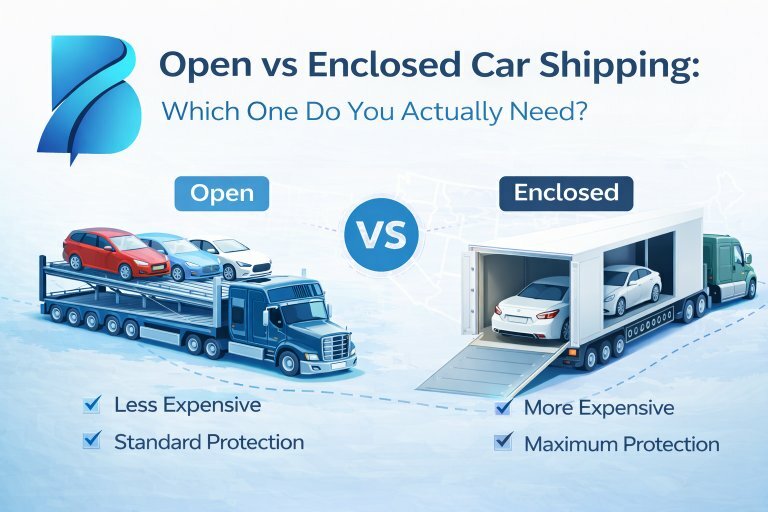
You've seen these on the highway a thousand times. Big multi-level trailers carrying 7-10 vehicles, stacked two high, rolling down I-95. That's open transport.
Your car is strapped down on the trailer, fully secured, but exposed to the elements. Rain, road dust, the occasional bug. The same stuff your car deals with sitting in your driveway or driving down the freeway.
About 90% of all vehicles shipped in the United States go on open carriers. Every new car that gets delivered to a dealership? Open carrier. That brand-new $55,000 Ford Mustang sitting on the dealer lot came off an open trailer three days ago. Toyota, Honda, BMW, Mercedes. They all ship their inventory on open carriers.
Think about that for a second. If open transport was risky, manufacturers wouldn't use it for billions of dollars worth of brand-new inventory.
What Enclosed Car Shipping Looks Like
Enclosed carriers are fully covered trailers, either hard-sided or soft-sided. They hold fewer vehicles, usually 2-6 cars, and your vehicle is completely protected from weather, road debris, and prying eyes.
The trailers often have hydraulic lift gates so your car never has to drive up a ramp, which matters for low-clearance vehicles. Some enclosed carriers even have climate control, though that's typically reserved for ultra-high-end moves.
You can read more about the full enclosed experience on our enclosed auto transport page.
The Cost Difference (Real Numbers)
Enclosed transport typically runs 40-60% more than open. Here's what that looks like in practice:
| Route | Open Transport | Enclosed Transport |
|---|---|---|
| New York to Florida (1,100 mi) | $750 - $1,000 | $1,100 - $1,500 |
| Chicago to Los Angeles (2,000 mi) | $1,000 - $1,300 | $1,500 - $2,000 |
| Coast to Coast (2,800 mi) | $1,200 - $1,600 | $1,800 - $2,400 |
That premium exists for a reason. Enclosed carriers haul fewer vehicles per trip, which means less revenue per load. The equipment costs more to buy and maintain. And the drivers who run enclosed loads are typically more experienced because they're handling higher-value cargo. All of that gets passed to you.
Who Actually Needs Enclosed Shipping
Let's be specific. Not vague "luxury car" advice. Actual scenarios.
Classic and collector cars
If you're shipping a 1967 Shelby GT500, a restored '69 Camaro, or any classic car you've invested serious money and time into, go enclosed. These vehicles often have original paint that's irreplaceable, chrome that pits easily, and value that hinges on cosmetic condition. A rock chip on a modern car is a $200 repair. A rock chip on a numbers-matching classic can knock thousands off the value.
Exotics and supercars
Ferrari, Lamborghini, McLaren, anything with a six-figure price tag and ground clearance measured in millimeters. These cars sit so low that loading them on a standard open carrier ramp can scrape the front splitter. Enclosed carriers with lift gates eliminate that risk entirely. Plus, carbon fiber body panels on a $300,000 car don't respond well to highway gravel.
Brand-new high-end luxury
Just took delivery of a new Porsche 911 Turbo S or a Mercedes-AMG GT? Enclosed makes sense. Not because open transport would destroy it, but because you're paying for peace of mind on a vehicle that hasn't had its first oil change yet. The paint has zero blemishes and you want it to arrive that way.
Show cars and race cars
If the car is going to a concours event, an auction, or a track day, enclosed is the right call. Presentation matters, and you don't want to spend two hours detailing road grime off a car that's about to be judged or photographed.
Vehicles with sentimental value that can't be quantified
Your late father's Corvette. The car you drove in high school that you just bought back after 20 years. The insurance payout wouldn't capture what this car means to you. Enclosed shipping gives you the extra protection and the peace of mind that comes with it. That's worth the premium.
Who Does NOT Need Enclosed Shipping
This is the bigger list, and I'm going to be direct about it.
Your daily driver. A 2024 Honda Accord, a 2023 Hyundai Tucson, a 2022 Subaru Outback. These are great cars. They don't need enclosed transport. They sit outside in parking lots every day. Open transport is perfectly fine.
Your "nice" car that isn't a collector. I get calls from people who want enclosed for a 2023 BMW 3 Series or a Lexus RX. I understand the impulse. You spent $50,000 on a car and want it protected. But the damage risk on open transport is genuinely under 1%. Your car faces more risk from the parking lot at the grocery store.
Used cars you bought online. You found a great deal on a 2021 Toyota Tacoma on Carvana or AutoTrader and need it shipped to you. Open transport. Every time. Save that extra $500 for new tires or an extended warranty.
Vehicles for a move or relocation. If you're moving from Phoenix to Portland and need your family car shipped, open is the standard. It's what the military uses for PCS moves, it's what corporations use for employee relocations. It works.
But What About Weather?
This is the question I get most. "What if it rains during transport?"
Your car is designed to handle rain. It sits outside in rain all the time. The only scenario where weather becomes a concern is hail, and carrier drivers actively avoid hail storms because those storms damage every car on the trailer, not just yours. No driver wants to deal with 10 simultaneous damage claims. They check weather forecasts and reroute.
Road salt in winter is a more valid concern for classic cars with exposed metal, which is another reason classics should go enclosed during colder months. But for modern vehicles with clear coats and rust protection? Rain and road spray wash off.
The Honest Recommendation
If your car is worth over $100,000, is a classic or collector, or has irreplaceable sentimental value, go enclosed. The extra cost is insurance for something that can't easily be fixed or replaced.
For everything else, open transport is the right choice. It's how the industry moves the overwhelming majority of vehicles, damage rates are extremely low, and you'll save hundreds of dollars that could go toward something more useful.
Still not sure? Run your route through our shipping cost calculator and you'll see quotes for both options. Or give us a call. We'll tell you straight up what we'd recommend for your specific vehicle. No upsell, no pressure. If you don't need enclosed, we'll say so.
You can also compare how each option works on our open car transport and enclosed auto transport pages.