
Licenses, Insurance & Compliance
Route, vehicle, timing, equipment, and carrier availability determine current pricing and planning windows. Review the written terms before booking.
Carrier coverage checked at assignment.
Licenses, Insurance & Compliance — At a Glance
Pricing and timing are shipment-specific estimates. Confirm the assigned carrier, equipment, pickup and transit windows, coverage terms, and cancellation terms in writing before pickup.
Is Bold Auto Transport licensed?
Yes, Bold Auto Transport is licensed by the U.S. Department of Transportation Federal Motor Carrier Safety Administration (FMCSA)
The FMCSA requires companies that operate commercial vehicles in interstate commerce, transporting passengers or hauling cargo, to be registered and hold a USDOT Number.
This registration ensures compliance with safety regulations and allows for monitoring of a company's safety information, including audits, compliance reviews, crash investigations, and inspections.
Bold Auto Transport proudly holds the required licenses and is fully insured.
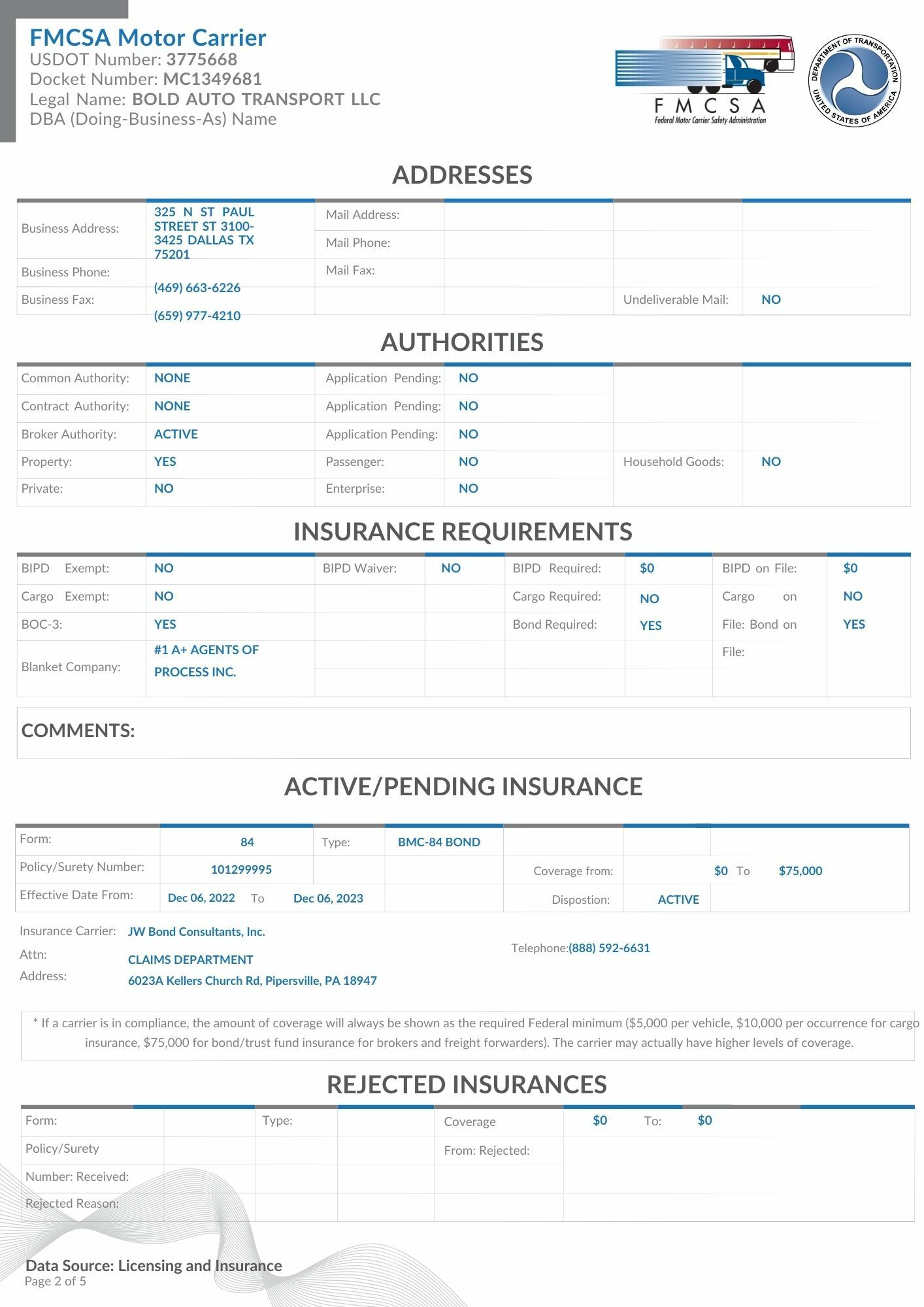
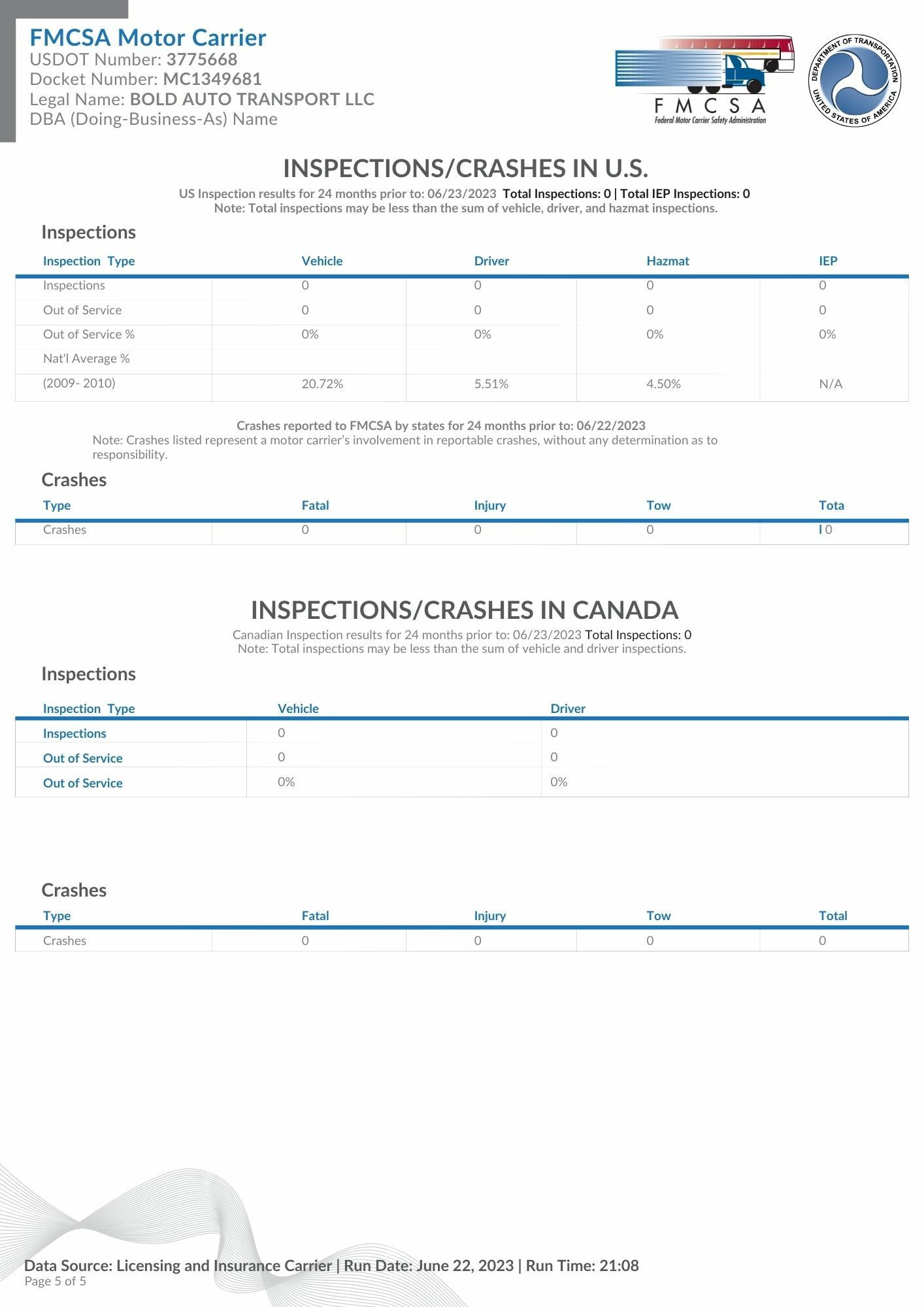
For reference, here are the licensing details of Bold Auto Transport:
USDOT Number: 3775668
Docket Number: MC1349681
You can download a PDF version of this information for your records.
Current-record notice: any credential image, rating, or status in CMS-managed copy can become outdated. The current official FMCSA authority and filing records control.
What Auto Transport License and Insurance Actually Mean
Interstate motor carriers and property brokers are subject to federal registration and authority rules administered by the Federal Motor Carrier Safety Administration (FMCSA). The required record depends on whether the company arranges transport as a broker or takes custody as a motor carrier; intrastate-only rules can differ.
A USDOT Number identifies an entity in FMCSA records, while an MC docket number can be tied to a specific operating authority. A displayed number is not enough by itself: verify the legal name, entity type, current authority status, and any required bond filing. Bold publishes USDOT 3775668 and MC-1349681 for that check.
USDOT 3775668 and MC-1349681 — What Each Number Means
People often see "USDOT" and "MC" used interchangeably, but they answer two different questions. Understanding the difference helps you read any transporter's credentials, not just Bold's.
USDOT 3775668 is the identifier Bold publishes for its federal registration record. Use it to cross-check the legal entity and address; do not infer current broker authority or carrier safety status from the number alone.
MC-1349681 is the docket number Bold publishes for its broker authority. Because authority and filings can change, check the current official record at booking instead of treating a footer badge or cached screenshot as proof.
How to Verify Our Federal Authority on FMCSA SAFER
You do not have to take any company's word for its credentials—including ours. Check current official FMCSA records before booking, and use the Licensing and Insurance record when authority or bond details are not clear in the SAFER snapshot. For process context, see how our car shipping process works.
- Go to the FMCSA SAFER company snapshot (safer.fmcsa.dot.gov), the free public lookup tool.
- Search by USDOT Number and enter 3775668.
- Review the snapshot. It shows the legal and DBA name, physical address, entity type, operating authority status, and whether the registration is active.
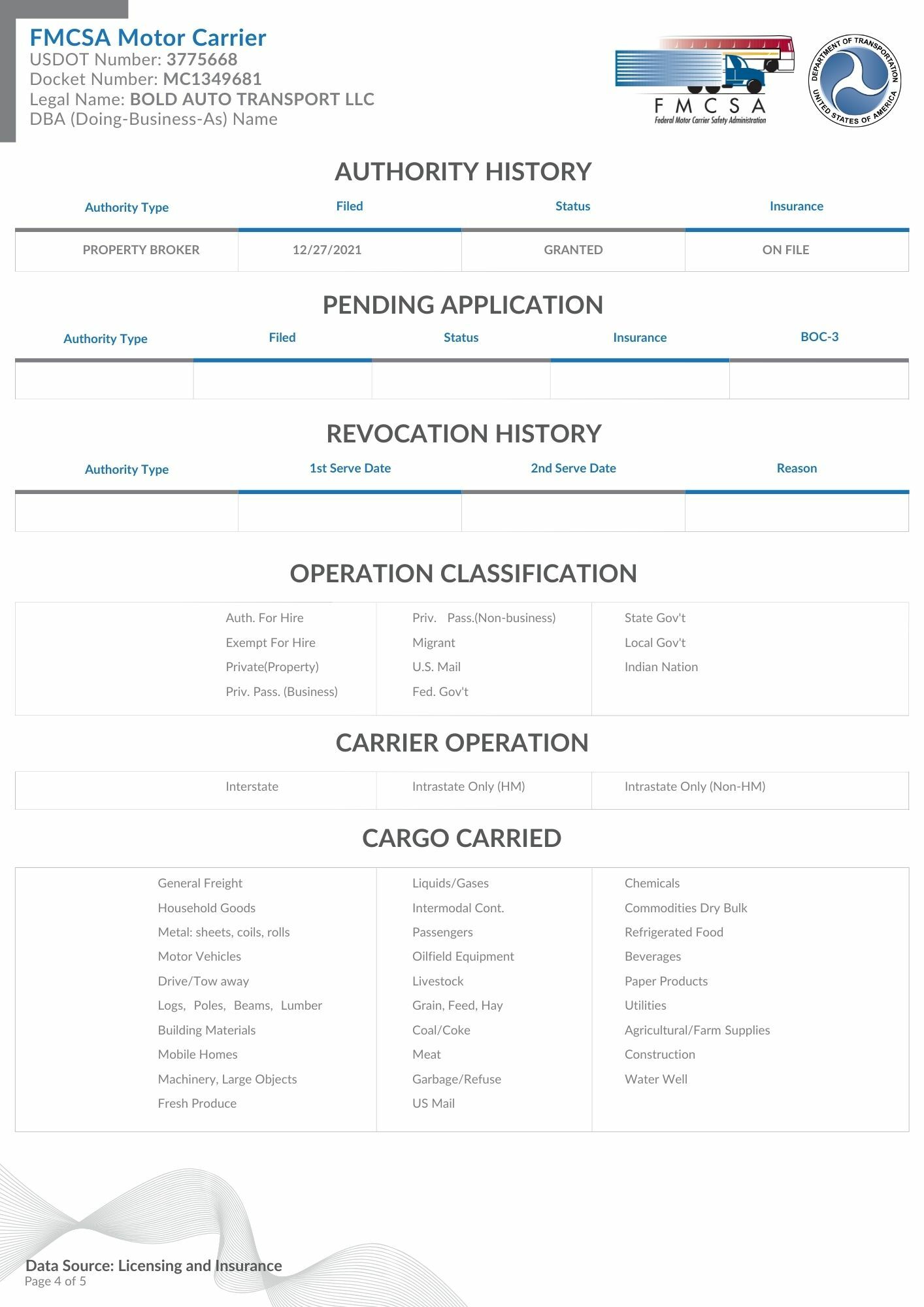
- Confirm the MC/MX/FF number listed matches MC-1349681, and that the operating authority is active and the entity is authorized for property brokerage.
- Cross-check the address and company name against what appears on this site. They should match exactly — Bold Auto Transport, 325 North St. Paul Street, Suite 3100, Dallas, TX 75201.
Recommendation: run the same current-record check for every broker you compare. If a company will not identify the legal entity or provide the numbers needed to verify the offered interstate service, do not proceed until the mismatch is resolved.
Broker Authority and the $75,000 Surety Bond
Bold Auto Transport acts as an auto transport broker, not the motor carrier taking custody. A broker arranges transportation with an independent carrier; current carrier acceptance, equipment, access, pickup, and transit remain shipment-specific.
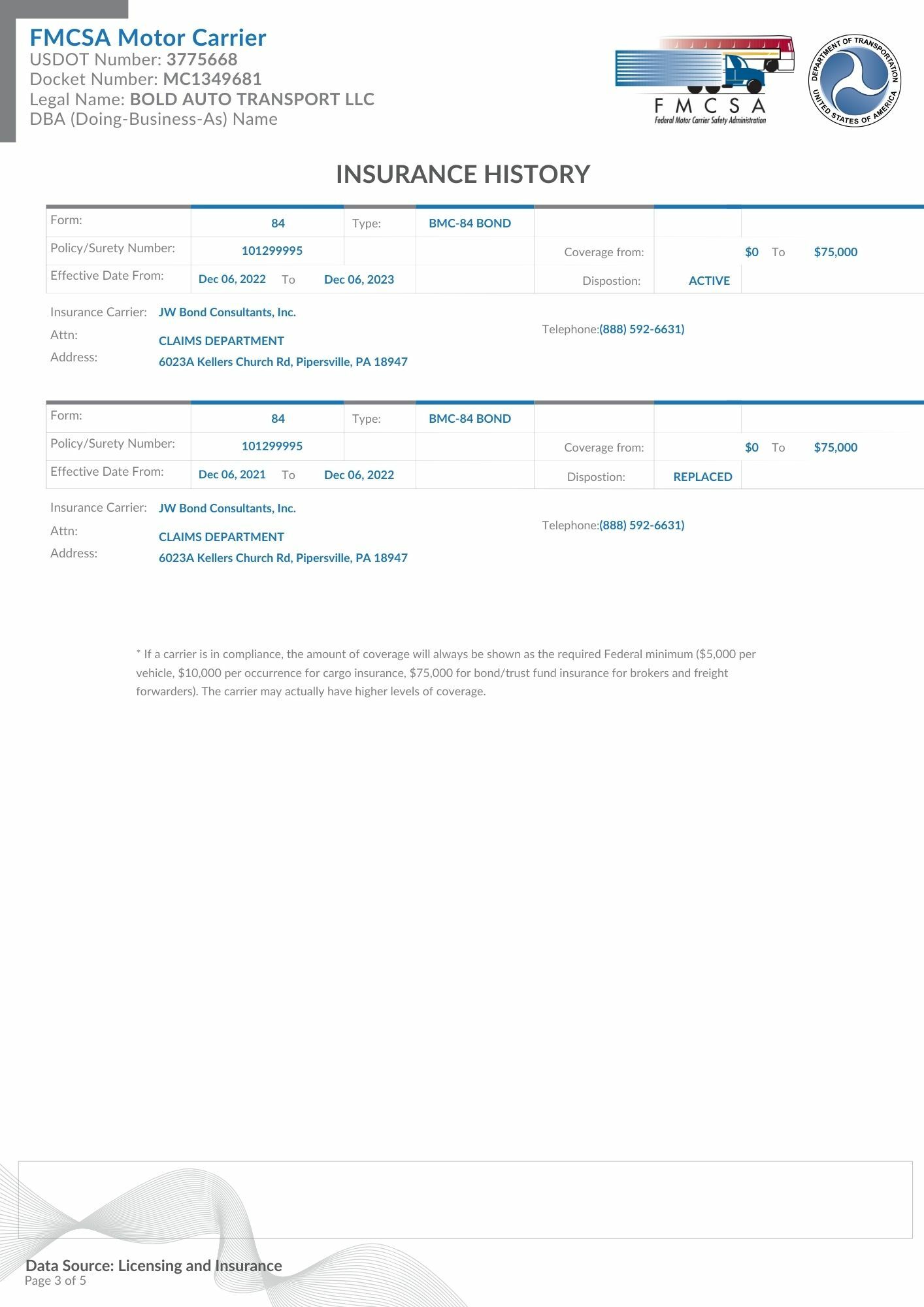
Federal broker-registration rules generally require a $75,000 BMC-84 surety bond or BMC-85 trust. The filing is not cargo insurance and does not promise reimbursement for every dispute. Verify Bold's current bond or trust filing in official FMCSA records and review the applicable eligibility and claim rules.
Insurance and Cargo Coverage Explained
Current broker authority permits an entity to arrange covered interstate transportation; it does not make the broker the motor carrier or insurer. Any cargo coverage comes from the policy of the assigned motor carrier.
After assignment, request the carrier's certificate of insurance and confirm that its legal name matches the company taking custody of the vehicle. Limits, deductibles, exclusions, valuation rules, covered causes of loss, policy periods, and claim decisions are carrier-policy specific. Bold can coordinate the documentation but cannot expand the policy or decide a claim.
What Cargo Insurance Typically Covers
- Potentially covered: direct physical damage caused by the carrier during loading, transit, or unloading, when the assigned policy covers that cause of loss and the evidence supports the claim.
- Common limitations: policies may exclude pre-existing damage, mechanical failure unrelated to handling, personal property, diminished value, or certain high-value vehicles and accessories.
- Why the deductible matters: the applicable deductible reduces a covered payment, so confirm the amount in the assigned carrier's documents rather than relying on a blanket insurance statement.
This is why the Bill of Lading is important evidence in the inspection and claim process.
How the Bill of Lading Protects a Claim
The Bill of Lading (BOL) is the inspection-and-condition report completed at pickup and again at delivery. It is key claim evidence because it helps show whether damage was present before the carrier took custody. The BOL does not expand coverage; the assigned carrier's policy still controls the limit, deductible, exclusions, and claim decision.
Here is how to use it correctly:
- At pickup, inspect the vehicle with the driver and record existing condition—scratches, dents, chips—on the BOL. Take your own date-stamped photos from all angles.
- During transit, keep the documented pickup condition as your baseline and use the agreed update channel and escalation path.
- At delivery, inspect the vehicle against the pickup BOL before signing. Note and photograph visible discrepancies, then follow the assigned carrier policy's notice requirements.
- If you need to file, the matched BOLs, photos, and the carrier's confirmed coverage are what move a claim forward. Bold helps coordinate the claim with the carrier and insurer.
Warning: inspect before signing when it is safe to do so. A clean receipt may make later proof more difficult; if conditions prevent a complete inspection, document the limitation and follow the assigned carrier policy's notice requirements.
How to Review an Assigned Carrier
The motor carrier—not Bold—takes custody of the vehicle. At assignment, verify the carrier using current official records and the actual documents for that load.
Before pickup, check:
- Legal identity and authority — match the carrier name and USDOT/MC record to the company and equipment arriving.
- Insurance documents — request the certificate and applicable policy terms; confirm dates, cargo limit, deductible, exclusions, valuation rules, and claim requirements.
- Equipment and access — confirm the trailer type, vehicle operability, modifications, and a safe, legal meeting point.
- Written order terms — compare the carrier, payment, pickup window, transit estimate, and cancellation terms with what you accepted.
Bold can coordinate these records, but customers should still review them before custody changes hands. A certificate is evidence of stated insurance, not a guarantee that a specific loss will be covered.
Why Licensing Protects You — A What-to-Check Table
Licensing is not paperwork for its own sake. Each credential maps to a specific protection you get as the customer. Use the table below to check any transporter, including the one you are reading about now.
| What to check | Where / how to verify | Why it protects you |
|---|---|---|
| USDOT Number | FMCSA SAFER — search USDOT 3775668 | Helps match the legal entity and published address; authority requires a separate current check |
| MC operating authority | FMCSA SAFER — confirm MC-1349681 is active | Confirms legal authorization to arrange interstate transport, not just registration |
| Broker bond or trust | Verify the current BMC-84/BMC-85 filing | May address eligible claims under its terms; it is not cargo insurance |
| Carrier cargo documents | Request the assigned carrier's certificate and applicable policy terms | Shows the stated limit and insurer; the policy still controls coverage and claims |
| Assigned carrier | Check current authority and available insurance documents at assignment | Helps verify the legal entity taking custody of the vehicle |
| Matching NAP details | Name/address must match across site, quote, and SAFER | Confirms you are dealing with the registered entity, not an imposter |
These checks reduce avoidable uncertainty but do not guarantee pickup, timing, delivery condition, or claim coverage. Resolve any mismatch before payment or pickup.
A Hypothetical Credential Check
Suppose a seller receives several estimates and one company refuses to identify its legal entity or put its authority number and payment terms in writing. The seller pauses rather than sending an irreversible payment.
The seller checks each current FMCSA record, confirms the matching company and address, then asks for the assigned carrier's authority and insurance documents before pickup. This scenario is illustrative, not a claim about a specific Bold customer or outcome.
The lesson is not that the lowest estimate is automatically wrong; it is that price cannot replace current authority, matching identities, written terms, and assigned-carrier documents.
Common Mistakes to Avoid
The red flags below are how unlicensed and untrustworthy operators reveal themselves. Avoiding these mistakes protects your vehicle and your money.
- Skipping the current-record check. Verify the legal entity, authority type, status, and required filing before booking.
- Accepting a refusal to share credentials. Do not proceed until you can match the offered interstate service to the correct legal entity and current authority.
- Using irreversible payment under pressure. Review the payment recipient, refund and cancellation terms, and dispute options before sending funds.
- Ignoring inactive or revoked authority. A USDOT number alone is not enough — if the MC operating authority shows inactive on SAFER, the company cannot legally arrange your shipment.
- Signing without inspecting. A clean delivery receipt may make later proof more difficult; document any inspection limitation and follow the carrier policy's notice rules.
- Assuming "insured" defines coverage. Confirm the assigned carrier's certificate, policy dates, cargo limit, deductible, exclusions, valuation rules, and claim requirements.
Why Verify a Registered Broker and Its Bond Filing
A registered broker gives the customer a legal entity and federal record to verify, but registration does not guarantee price, timing, carrier performance, delivery condition, or cargo coverage. The required broker bond or trust has its own eligibility and claim terms and is not a substitute for the assigned carrier's cargo policy.
Bold publishes USDOT 3775668, MC-1349681, and its Dallas address. Verify those current records directly, then confirm the assigned carrier and choose open or enclosed equipment based on the vehicle, route, availability, and written estimate.
Verify, Then Ship With Confidence
Choosing an auto transport company should never come down to whoever sends the cheapest text. Verify the broker's authority and bond, then verify the assigned motor carrier's identity, operating status, and insurance documents. Bold publishes USDOT 3775668 and MC-1349681 so customers can check its broker credentials before committing.
Verify the current FMCSA record, confirm the assigned-carrier policy terms, and inspect against the Bill of Lading at both ends. To request route-specific terms, request an estimate or speak with a transport coordinator at (469) 942-5444.
What customers say
Real reviews pulled live from our public review feed.
This was my first experience getting a vehicle transported and Andrew made this experience smooth and easy despite all the problems I faced with the car dealership to a driver not showing up for pick up. Andrew was with me every step of the way and worked so h…
Recently transported a vehicle from Massachusetts to Dallas, Alan was extremely professional and always on top of everything. I did had an issue with my transport, but once I notified Alan, he immediately jumped on to it and got everything sorted. On the day o…
Very professional service! I was unsure of who to look for with transporting my new Toyota Tacoma. I had never done anything like this before, so I was very much confused. Bold reached out to me and walked me through the whole process in a simple explanation. …
Licensing & Insurance FAQs
The questions we get most about Bold's FMCSA authority, broker bond, carrier vetting, and assigned-carrier insurance-document review.
How do I verify Bold Auto Transport is licensed?
Start with USDOT 3775668 on the free FMCSA SAFER website, then use the current Licensing and Insurance record to confirm MC-1349681, broker authority status, and any required bond or trust filing.
What is the difference between a broker and a carrier?
A motor carrier takes custody and physically moves the vehicle. A broker arranges transportation with an independent carrier. Bold is the broker; current lane availability and carrier acceptance remain shipment-specific.
Is my vehicle insured during transport?
Any cargo coverage comes from the assigned motor carrier, not Bold. After assignment, request the carrier's certificate of insurance and confirm the policy limit, deductible, exclusions, valuation rules, effective period, and claim requirements before pickup.
What is the broker surety bond and why does it matter?
Federal broker-registration rules generally require a $75,000 BMC-84 surety bond or BMC-85 trust. Coverage and eligibility depend on the filing and applicable rules, so verify the current record and do not treat the bond as cargo insurance.
What should I do if my vehicle is damaged in transit?
Note the new damage on the delivery Bill of Lading, photograph it, and avoid signing a clean receipt. The matched pickup and delivery Bills of Lading, your photos, and the carrier's confirmed coverage are what support the claim, and Bold helps coordinate it with the carrier and insurer.
How should I verify the assigned carrier?
Before pickup, confirm the assigned carrier's legal identity and current authority in official records. Request its insurance certificate and applicable policy terms, including dates, cargo limit, deductible, exclusions, valuation rules, and claim requirements.
Popular Car Shipping Locations
Explore address-based vehicle-transport routes. Pickup and delivery depend on current carrier availability and safe, legal access.
Need a route-specific estimate?
Share your route, vehicle, and timing. Review the current estimate and written terms before you book.
USDOT #3775668 · MC #1349681 · BBB A+ Accredited · Carrier coverage checked at assignment